Spot AI Knitting Patterns: 7 Red Flags & Fixes
Learn to spot AI-generated knitting patterns with 7 red flags, plus ethical tips for fixing flawed designs or finding human-made alternatives.
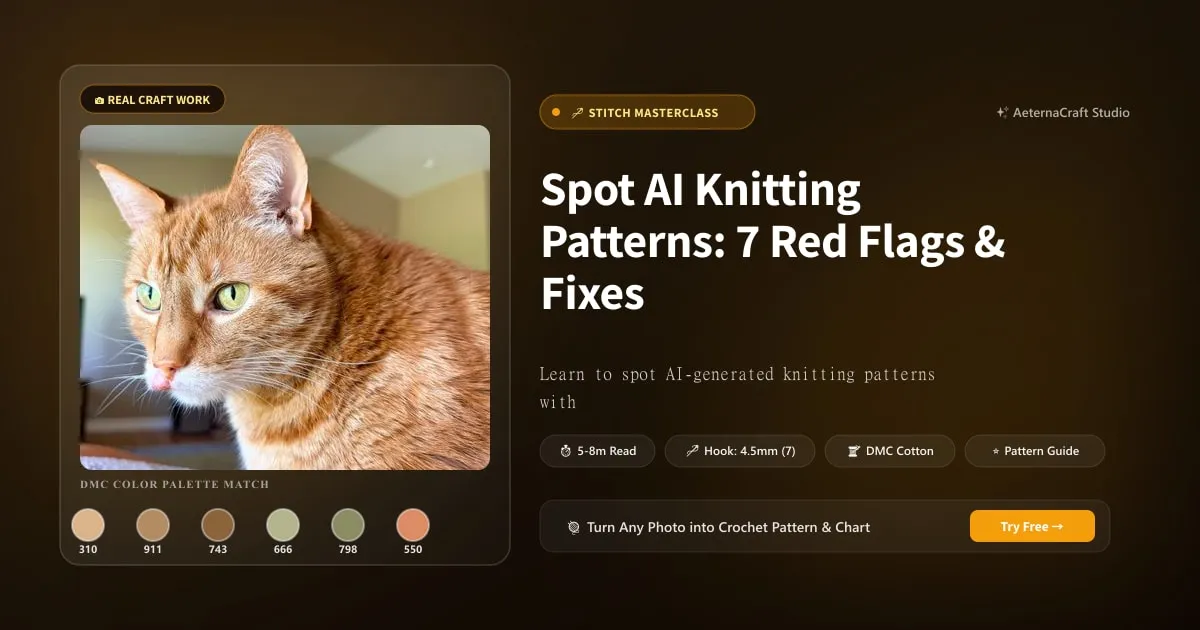
Red Flags: How to Spot AI-Generated Knitting Patterns
Visual Clues in Pattern Listings
Honestly, staring at a pattern photo used to bring me pure joy. Now, I catch myself squinting at the screen, tea steaming beside me, wondering if I’m looking at actual yarn or a digital dream. The first place you’ll spot the trouble is in the photography itself. AI-generated listings often feature unnaturally perfect lighting, seamless background gradients, or motifs that look surreal rather than handcrafted. Think of that infamous ‘Crazy Cat Woman’ pattern that circulated last spring. The cat face on the chest looked impossibly symmetrical, but zoom in once, twice, three times, and the whiskers melt into the ribbing. The ears seem to float slightly above the neckline. When I first tried to reverse-engineer a similar design back in 2008, I spent three entire evenings sketching on graph paper because anatomy matters in fiber work. AI doesn’t care about anatomy. It cares about pixels.
You’ll also notice repeated motifs with subtle errors. A cable panel might repeat flawlessly, except the crossing direction flips halfway down the body. Or a colorwork stripe will shift by half a stitch without explanation. These aren’t just typos; they’re structural impossibilities. If you’re used to working with a 4.0mm hook or a 3.5mm needle, you know how easily a half-stitch misalignment can throw off an entire panel. AI often ignores tension consistency entirely. The photos will show bulky, fluffy textures that look like they were made from thick merino wool, but the listed yardage barely covers a pair of socks. That mismatch screams algorithm, not artisan.
Textual Red Flags in Pattern Descriptions
Let’s talk about the copy. A human designer will tell you exactly what they tested, what gauge they aimed for, and which needles they prefer. AI tends to wander into vague territory. Phrases like “soft and cozy” or “beautiful drape” sound lovely over a cuppa, but they mean nothing when you’re holding a skein. Look for descriptions that skip gauge entirely or offer contradictory numbers. One listing might claim a finished chest measurement of 38 inches while another size chart says 42 inches. Another common trick is omitting yardage completely, or suggesting you need 1800 meters of fingering weight yarn when the stitch count clearly only requires 950.
When I encountered a pattern claiming to be worked in the round with a series of single crochet (sc) and double crochet (dc) instructions mixed into flat knitting rows, I nearly dropped my mug. You can’t seamlessly transition between those constructions without clear transitional notes, and AI rarely provides them. Instead, you’ll find instructions that say “repeat until it looks right” or “adjust based on preference.” Preference isn’t a measurement. If you’re planning to work with worsted weight acrylic or a delicate silk blend, you need exact stitch counts per inch, not poetic suggestions. I’ve seen patterns list 120 stitches for a child’s size and 118 for an adult medium. Numbers don’t lie, but algorithms certainly do.
Checking the Seller’s History and Reviews
Your final line of defense is the shop itself. Flip through the seller’s profile. Are there twenty patterns uploaded in the same week? Do they all share that same glossy, slightly uncanny aesthetic? Look closely at the reviews. Buyers will frequently mention missing stitches, impossible shaping, or yarn recommendations that completely contradict the designer’s notes. A trustworthy maker will have test knitters listed, progress photos showing swatches, and comments that reference specific needle sizes or hook sizes like H/8. I always recommend running a reverse image search on the main pattern photo. Nine times out of ten, you’ll discover the image was pulled from a stock library or stitched together from unrelated craft blogs.
How many of you have ever bought a pattern that promised a quick weekend project, only to spend three days untangling a mess of conflicting instructions? I have. More times than I care to admit. The difference between a seasoned designer and a prompt-generator is accountability. Human makers publish corrections. They email test knitters. They care if your cuffs roll up or your neckline gapes. AI only cares about generating enough tokens to sell another download. Take your time. Cross-reference. Ask yourself: does this feel crafted by someone who’s actually felt the scratch of unmercerized cotton, or does it feel like it was assembled by a machine that’s never held a spindle? Your future self will thank you when you’re not staring at a pile of misaligned stitches wondering where it all went wrong.
Ethical Dilemma: Should You Knit an AI Pattern You Already Bought?
The Case Against Using AI Patterns
So you clicked “buy,” got the file, and now you’re sitting there with a skein of alpaca in one hand and a sinking feeling in the other. The money is spent, but the knot in your stomach remains. Many of us in the fiber community draw a hard line here: we don’t support patterns generated by algorithms that bypass decades of skill-testing, swatching, and community feedback. When you knit an AI pattern, you’re indirectly funding a system that floods platforms with derivative, error-prone designs. It devalues the hours human designers spend grading sizes, testing yarn substitutions, and ensuring their charts actually translate to fabric. The knitting community has spoken loudly on forums and marketplaces—there’s a growing consensus that buying these patterns perpetuates a cycle where quick, cheap content pushes out careful, tested craft. I respect that boundary. I’ve stood in local yarn stores watching designers argue over gauge tolerances for weeks. That patience matters.
The Case for Using a Purchased Pattern
That said, life happens. You see a beautiful photo, you impulse-buy, and by the time you realize the instructions read like a riddle written by a sleep-deprived poet, the purchase window has closed. You already own the digital file. What’s a crafter to do? Some of us choose to salvage the idea rather than let it gather digital dust. If the pattern features a charming cat motif or a clever colorblock layout, you can absolutely honor that spark without following the flawed blueprint. Repurposing isn’t cheating; it’s craftsmanship. You might take the silhouette, swap the impossible construction for something manageable, and draft your own chart. Honestly, I’ve done this more times than I can count. There’s something deeply satisfying about taking a broken idea and coaxing it into wearable reality. Your money is already spent, but your time and skill are yours to direct however you choose.
How to Adapt an AI Pattern to Make It Work
If you decide to forge ahead, treat the original file as a rough sketch, not a bible. Start by recalculating gauge. AI patterns often assume a standard tension that rarely exists outside a computer simulation. Knit a proper swatch in your chosen fiber—whether it’s mercerized cotton or soft merino wool—and measure it under light steam or blocking. Adjust your needle size accordingly. A pattern calling for a 3.5mm hook to achieve dense fabric might actually work better at 4.0mm if your natural tension runs loose. Next, rechart any motifs. Graph paper became my best friend years ago when I tried to follow a pattern that claimed a cable twist happened every fourth row but showed decreases on the third. I traced the stitches manually, counted the repeats, and rebuilt the sequence.
Simplify complex sections that defy logic. If the instructions demand a treble (tr) increase cluster in a tight ribbing panel, cut it down to a half double crochet (hdc) shell or skip it entirely. The garment will still function, and your wrists will stop hurting from constant over-manipulation. Use the ‘Crazy Cat Woman’ pattern as a case study: strip away the impossible facial structure, replace the tangled yarn-over chain with a clean slip stitch (sl st) border, and work the body in straightforward rows. You’ll end up with something you’re proud to wear, and you’ll have learned more about fabric manipulation than blindly following a broken script ever taught you. Does it feel like compromise, or does it feel like taking the wheel? Most of us know exactly which answer makes our needle cases happier.
How to Fix Common AI Pattern Errors
Gauge and Sizing Issues
Let’s address the elephant in the studio: gauge. AI generators treat numbers like suggestions. They’ll list a tension of 18 stitches per 4 inches, but omit whether that’s on large circular needles or fine bamboo straight ones. Without that context, your finished piece will either look like a stiff carpet or drape like a wet napkin. The fix starts with a proper swatch. Cast on at least 30 stitches, work in the designated stitch pattern, and measure the center. If you’re falling short of the stated gauge, move down a size. Overshooting? Move up. I remember spending an entire afternoon unraveling a hat because I assumed a bulkier yarn would compensate for loose tension. It didn’t. The brim gaped, the crown puckered, and my pride took a serious hit. Thankfully, swapping to a finer needle saved the day, but the lesson stuck. Always recalculate stitch counts for your specific gauge. Multiply your circumference by your stitches-per-inch, not the AI’s placeholder number. Sizing charts become accurate again when you anchor them to real fabric.
Nonsensical Construction Instructions
Then there are the assembly instructions that read like modern art criticism. “Join at shoulder,” they’ll say, but never mention how many stitches to pick up along the armhole. Or they’ll demand you work a seamless bodice in the round while simultaneously shaping raglan decreases on the same row. Impossible, right? My strategy is to break everything down into physical steps. Lay out your pieces before you cut a single yarn. Sketch the seams. Consult a basic stitch dictionary to verify if the shaping technique actually exists outside a fantasy world. When I encountered a pattern claiming you could join a back panel to a front panel using only a single row of double crochet (dc) without picking up stitches along the edge, I knew something was fundamentally broken. I picked up three stitches per row, worked evenly around, and finally achieved a clean join.
Don’t be afraid to pause and consult online crafting communities when the math refuses to cooperate. Experienced makers love to troubleshoot illogical instructions. Post your swatch photos. Share the confusing row. Someone will inevitably reply with, “Oh, that’s just a typo—they meant decrease here.” Flexibility saves projects. Blind obedience to flawed text destroys them. You’ve got this. Just take a breath, grab your favorite interchangeable set, and trust your hands over the algorithm.
Motif and Colorwork Problems
Colorwork charts generated by machines often suffer from misaligned repeats or symbols that don’t match standard notation. A snowflake motif might appear to have six points, but the chart shows eight loops. A stray black square where white should be can turn a clean graphic into a muddy blotch. My solution is always recharting. Print the original diagram, trace it over, and verify every crossing with a small hand-knitted or crocheted test swatch. If you’re working with a sturdy wool or a smooth acrylic, the contrast will show mistakes instantly. For intricate designs like the cat face mentioned earlier, I switch to a clearer method: I map the motif onto graph paper, assign each color a number, and count the rows aloud to ensure symmetry. Testing with fingering weight scrap yarn costs pennies but prevents wasting whole skeins. Once the chart aligns physically, the fabric follows suit. Have you ever stared at a colorwork motif and realized halfway through that the pattern mirror-image flipped unexpectedly? I have. It taught me to trust my eyes, not just my eyes on a screen.
Finding Ethical Alternatives: Where to Get Reliable Patterns
Trusted Independent Pattern Designers
When you’re ready to step away from the algorithm and back toward human hands, the internet is genuinely overflowing with brilliant makers. Designers like Tin Can Knits and Caitlin Hunter have built reputations on meticulous grading, transparent testing processes, and genuine community engagement. Platforms like Ravelry, LoveCrafts, and independent Etsy shops host thousands of verified creators who openly share their swatching photos, test knit schedules, and revision histories. Look for tags like “tested,” “human-made,” or “community-grafted.” Read the description of their design process. Do they mention which needles or hooks they used? Do they list specific fiber recommendations for drape versus warmth? Those details signal care.
I’ve spent two decades watching independent makers grow from hobbyists into industry staples. Their strength lies in iteration. When a pattern fails a test knit, they fix it, reprint it, and often email past buyers with corrections. That level of accountability simply doesn’t exist in mass-generated files. Filter your searches by designer reputation, not just aesthetic appeal. Support the makers who treat their craft like a conversation, not a product dump.
How to Support Ethical Designers
Buying the pattern is only the beginning. Engage with the maker. Leave thoughtful reviews that mention how the gauge translated to your yarn choice. Tag your finished objects. Share project threads that highlight adjustments you made. Designers thrive on visibility, and honest feedback helps future knitters succeed. Many indie creators offer test-knit invites, early-bird pricing, or free blog tutorials alongside their paid patterns. Participate when you can. It builds a healthier ecosystem where skill is rewarded, not overshadowed by cheap volume. Personally, I keep a dedicated folder of favorites on my dashboard. When I need a reliable stitch guide or a well-graded silhouette, I scroll there first. Knowing your maker matters. It turns commerce into connection.
Using AI Patterns as Inspiration for Original Designs
Finally, consider channeling that initial spark into something entirely yours. AI can generate a stunning concept—a whimsical sweater, a geometric motif, a bold color clash—but you hold the tools to make it wearable. Take the theme, draft your own chart, calculate your own gauge, and write instructions that reflect your actual tension. Learn basic pattern drafting through local workshops or reputable books. Experiment with grading from XS to 3XL using proportional formulas. There’s profound joy in creating from scratch. You’ll stumble, yes, but every misstep teaches you how fabric behaves. I’ve turned countless “meh” algorithm outputs into beloved personal patterns. The freedom is unmatched. Why borrow broken blueprints when you can build something that fits your hands, your style, and your pace?
The Knitting Community’s Stance on AI Patterns
Why Many Knitters Reject AI Patterns
The fiber community isn’t anti-technology; we’re pro-craft. Rejection of AI patterns stems from genuine concerns about quality, sustainability, and artistic integrity. When algorithms flood marketplaces, they drown out makers who spend months refining a single silhouette. Test knitters report skipped stitches, mismatched increases, and yarn recommendations that completely ignore fabric behavior. Beyond the technical failures, there’s the emotional cost. Knitting is relational. We share swatches, troubleshoot together, celebrate finished objects, and mourn frogged experiments. AI erases that shared labor. It treats craftsmanship as content. Many of us view this as a threat to the tradition of passed-down techniques, hand-tested gauges, and community-vetted instructions. When you buy an AI pattern, you’re not just purchasing a file; you’re voting for a system that prioritizes speed over skill. And honestly, that sits heavy on our hearts.
How to Report and Flag AI Patterns
Most major platforms now allow users to flag suspicious listings. If you encounter a pattern with reversed images, inconsistent sizing, or obviously synthetic instructions, document everything. Screenshot the gallery, note the gauge contradictions, and record the seller’s upload history. Submit reports to Etsy’s intellectual property team, Ravelry’s moderation channels, or LoveCrafts’ customer support. Include specifics: “Row 42 demands a slip stitch (sl st) decrease that contradicts the stated stitch count,” or “The model photo shows a 4.0mm hook result, but the pattern lists 3.5mm needles.” Platforms move faster when you provide clear evidence. I’ve successfully reported dozens of listings this way. It takes fifteen minutes, but it protects dozens of other crafters from wasting yarn on impossible designs.
Educating Fellow Knitters on AI Risks
Awareness spreads quietly at first, then all at once. Share your findings in local knitting circles. Post comparison threads showing human-tested charts versus algorithm-generated charts. Create simple guides that walk beginners through gauge verification and construction basics. When newcomers understand why certain instructions matter, they stop accepting vague templates as standard. I’ve hosted coffee-and-crochet meetups where we dissected real pattern flaws side-by-side. The participants left armed with critical eyes and solid checklists. Education isn’t about shaming; it’s about empowerment. We owe it to each other to preserve the integrity of our craft. Talk openly. Ask questions. Demand transparency. Together, we keep the fibers flowing true.
Frequently Asked Questions
How can I tell if a knitting pattern is AI-generated?
Look for visual clues like unnaturally perfect photos with seamless backgrounds, motifs that melt into ribbing when zoomed in, or repeated patterns with subtle errors like cable crossings flipping direction. Textual red flags include vague descriptions like 'soft and cozy' without gauge details, contradictory measurements, or instructions that mix single crochet with flat knitting rows without transitional notes.
Should I knit an AI pattern I already bought?
It depends on your ethics and patience. Many knitters reject AI patterns because they devalue human skill and testing. But if you already own the file, you can salvage the idea by treating it as a rough sketch: recalculate gauge, rechart motifs, and simplify nonsensical sections. Your money is spent, but your time and skill are yours to direct.
How do I fix common errors in AI knitting patterns?
Start with a proper gauge swatch—cast on at least 30 stitches and measure the center. Recalculate stitch counts for your specific tension. For nonsensical construction, break instructions into physical steps, sketch seams, and consult stitch dictionaries. Rechart colorwork motifs on graph paper and test with scrap yarn before committing to full skeins.
Related Posts
Starsky & Hutch Cardigan: Fix Chunky Knit Sizing Issues
Troubleshoot oversized or misshapen cardigans from yarn substitution, gauge mismatches, and pattern adjustments. Get expert tips to salvage your project.
TroubleshootingFix Rigid Jester Hat Horns: Slouchy Crochet Tips
Learn how to fix stiff, rigid crochet hat horns and achieve a slouchy look. Expert tips on stuffing, yarn choice, and pattern modifications.
Try Our Free Crochet Tools
Turn Your Photo Into a Crochet Pattern
Upload any photo and our AI generates a pixel-perfect crochet pattern with real yarn color matching in seconds.
Try AeternaCraft Studio Free →Calculate Yarn for Any Resize
Free amigurumi yarn & resizing calculator. Change hook, switch yarn, or scale a whole pattern — instant results with PDF export.
Open the Calculator →